How to Do Reverse Crunches: The Definitive 5-Step Guide
Are you grinding through countless reverse crunches, only to be left with a sore neck and a stubborn lower belly that refuses to tighten? The issue isn't your effort — it's a fundamental misunderstanding of how your core truly works. Modern exercise science reveals that a strong core is not about six-pack visibility, but about unseen stability: the ability to brace your torso as a solid unit for powerful, safe movement. This is where the reverse crunch shines. It's not merely an alternative to the traditional crunch; it's a foundational drill for teaching your body essential pelvic control and intra-abdominal pressure. Research confirms it activates key stabilizing muscles more effectively than its traditional counterpart. This guide moves beyond simple sculpting. You'll master a biomechanically sound 5-step technique, understand its place in a holistic core training pyramid, and learn to integrate it into a smart routine that builds resilience from the inside out. Let's rebuild your core, the right way.
Part 1: Redefining "Core": It's a Stabilizer, Not a Mover
Forget the idea of "core" as just your six-pack muscles (rectus abdominis). True core function is about stability, not motion. Think of your core as a muscular cylinder:
- Front & Sides: Transverse abdominis (deep corset), internal/external obliques.
- Back: Multifidus, erector spinae (spinal stabilizers).
- Top & Bottom: Diaphragm (breathing muscle) and pelvic floor.
This system's primary job is to create stiffness and prevent unwanted movement in your spine when your arms and legs move. The reverse crunch is a primer for this skill. Unlike a traditional crunch that focuses on spinal flexion (rounding forward), the reverse crunch teaches you to posteriorly tilt your pelvis using your lower abdominals while keeping your ribcage stable — a fundamental pattern for spinal health and power transfer.
Scientific Edge: A 2022 study in the Journal of Strength and Conditioning Research confirmed that exercises like the reverse crunch elicit high activation in the lower abdominal region. More critically, a 2023 review in Sports Health pointed out that integrated core stability training, which includes pelvic control exercises, for improving athletic performance and reducing injury risk is significantly superior to isolated flexion work such as traditional crunches.
Part 2: Reverse Crunch Form — The 5-Step Master Blueprint
Precision here is non-negotiable. The goal is to isolate the lower abdominal contraction, not to generate momentum.
Step 1: Foundational Setup & Bracing
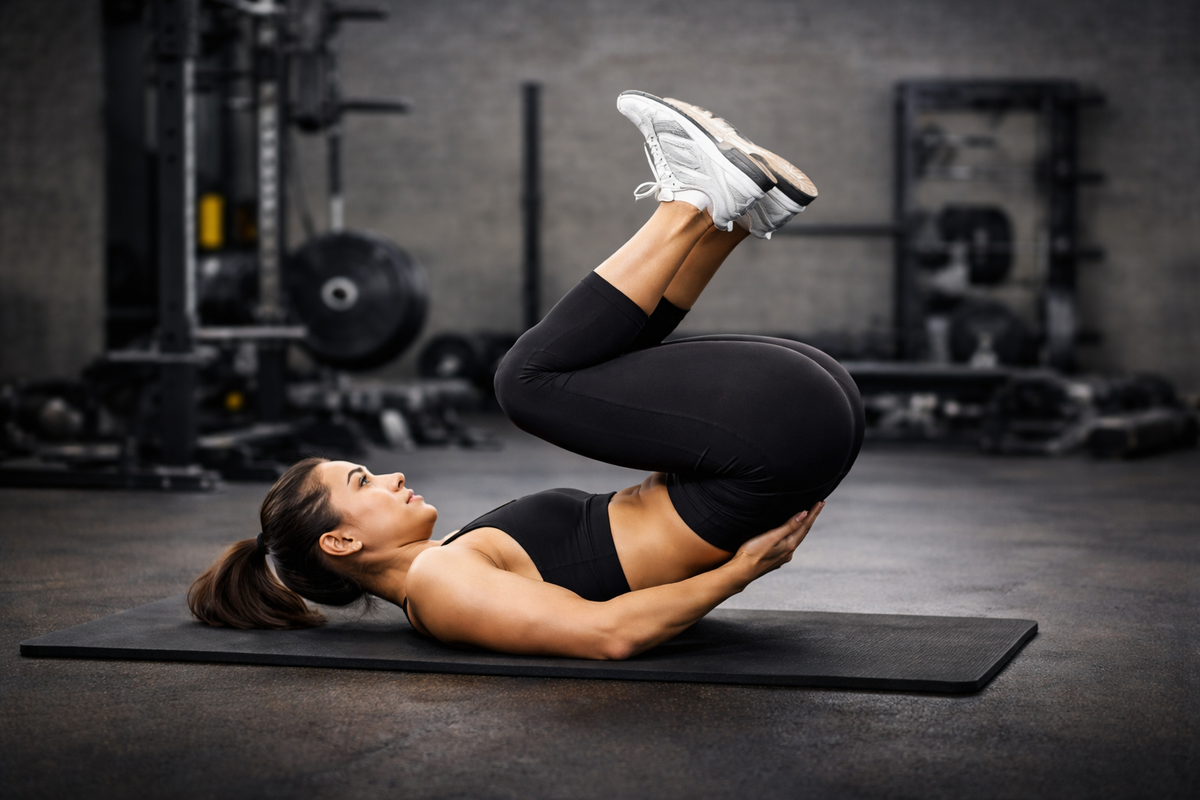
Lie supine on a mat. Bend knees to 90 degrees, feet hovering 2-3 inches off the floor. Place hands palms-down beside you or under your glutes for posterior pelvic support. Before any movement, take a breath into your diaphragm and gently brace your core as if preparing for a light punch — engage your "corset" without holding your breath.
Step 2: Initiate with Pelvic Tilt
Exhale and slowly draw your belly button toward your spine. Initiate the movement by gently tucking your tailbone upward, causing your lower back to flatten against the mat. This is the posterior pelvic tilt — the core of the exercise.
Step 3: Controlled Hip Lift
Continuing the exhale, use the lower abdominals to curl your hips 2-4 inches off the floor. Imagine lifting your pelvis toward your ribcage. Your knees will naturally move toward your chest. Keep your upper back and shoulders relaxed and grounded.
Step 4: Peak Contraction & Lowering
At the top, pause for a one-count, focusing on the deep squeeze in your lower abdomen. Inhale as you slowly, with full control, lower your hips back to the start position, maintaining the posterior tilt until your hips touch down. Crucially, keep your feet elevated to sustain tension.
Step 5: Reset & Repeat
Release the brace momentarily at the bottom, reset your breathing and brace, then begin the next repetition. Quality supersedes quantity.
Critical Safety & Form Checklist
- ✅ DO: Move slowly (2 seconds up, 1-second pause, 2 seconds down). Keep ribs down. Focus on pelvic movement.
- ❌ DO NOT: Swing legs using momentum. Let your back arch off the floor on the descent. Strain your neck or pull with your arms.
- ⚠️ STOP IMMEDIATELY IF: You feel any sharp or pinching pain in your lower back or hips. This indicates improper form or a potential underlying issue.
Reverse Crunch Form Self-Check Table
| Correct Signals (✅) | Dangerous Signals (❌) |
|---|---|
| Lower abdomen has a burning sensation | Lower back has a squeezing or stabbing pain |
| Pelvis is "rolling" upward | Legs are swinging forcefully |
| Shoulders stay glued to the mat at all times | Neck feels tense, shoulders lift off the mat |
| Movements are slow and controlled | Movements are fast and rely on momentum |
Part 3: Strategic Progressions & The Core Training Pyramid
Once you can perform 3 sets of 15 perfect reps, progress strategically. View your core development as a pyramid:
- Level 1: Motor Control & Isolation (You are here with the basic reverse crunch)
-
Level 2: Anti-Extension (Resisting your back from arching)
- Progression: Weighted Reverse Crunch. Hold a light med ball or dumbbell between your knees. The added load challenges your ability to maintain the pelvic tilt.
-
Level 3: Anti-Rotation & Anti-Lateral Flexion (Resisting twisting and bending)
- Progression: Single-Leg Reverse Crunch. Extend one leg straight out. This asymmetric load forces your obliques and deep core to work overtime to keep your torso square.
-
Level 4: Integrated Stability & Dynamic Control
- Progression: Hanging Knee Raise. From a dead hang on a bar, use your core to lift your knees, maintaining a neutral spine. Warning: This is an advanced move requiring shoulder stability and solid prerequisite strength.
Part 4: Building Your Complete Core Training System
The reverse crunch is one tool. A resilient core requires training all its functions. Here is a sample weekly framework:
| Training Day | Primary Function | Sample Exercises | Sets x Reps/Time |
|---|---|---|---|
| Day 1 | Anti-Extension & Pelvic Control | Reverse Crunch | 3x12-15 3x30-45s |
| Day 2 | Anti-Rotation & Lateral Stability | Pallof Press | 3x10/side 3x20-30s/side |
| Day 3 | Integrated Strength | Farmer's Carry | 3x40m 3x15 2x20m |
Frequency: Train core 2-3 times per week, with at least one day of rest between sessions focused on the same function.
Part 5: Reverse Crunch Benefits & Essential Considerations for Safety
The benefits of reverse crunches extend far beyond aesthetics, directly contributing to spinal health and functional strength.
For Lower Back Pain & Safety: If you are considering reverse crunches for lower back pain, extreme caution is advised. Always consult a physical therapist before beginning. A safer entry point is the "Drawing-In" maneuver: lie on your back, knees bent, feet flat, and practice only bracing your transverse abdominis (pulling navel to spine) without moving your pelvis or ribs. Master this before attempting any leg movement.
Breathing is Part of the Brace: Do not hold your breath. Practice 360-degree breathing: inhale to expand your belly and ribs laterally, exhale to engage the brace.
Nutrition & Recovery: Core muscles require recovery like any other. Ensure adequate protein intake and prioritize sleep. Remember, reducing body fat to reveal muscle definition happens primarily in the kitchen through a sustained caloric deficit and whole-food diet.
Conclusion: From Isolation to Integration
The reverse crunch is your gateway to understanding true core function. It teaches the critical skill of pelvic control that underpins every squat, deadlift, and functional movement. By mastering its form, strategically progressing it, and placing it within a comprehensive core training system, you stop chasing fleeting aesthetics and start building a foundation of lasting strength and resilience. This is how you build a core that doesn't just look strong, but performs powerfully and protects you for a lifetime.
Begin not with a hundred reps, but with five perfect ones. Feel the difference.
References
-
Journal of Bodywork and Movement Therapies. (2025). Electromyography activity of the abdominal muscles during exercises with and without aid from upper limbs in healthy individuals: A cross-sectional study. This study aimed to compare the EMG activity of the abdominal and shoulder extensors muscles during traditional curl-ups, modified curl-ups, and roll-ups with balls.
Read the study. - PubMed. (2024). Abdominal Hollowing vs. Abdominal Bracing: A Scoping Review of Clinical Trials on Effectiveness for Trunk Stability and Rehabilitation. The findings suggest that personalized rehabilitation programs incorporating both AH and AB, tailored to individual patient needs and rehabilitation goals, can be effective in managing and preventing LBP. Read article.
- BMC Sports Science, Medicine and Rehabilitation. (2024). The investigation of ultrasound to assess lateral abdominal wall activation with different types of core exercises. Core training is the foundation of physical exercise. The activation of the lateral abdominal wall (LAW) muscles in the core muscles, particularly the transversus abdominal (TrA) muscles, has a stabilizing effect on the chest and abdomen. Therefore, we need to focus on the training effect of the TrA. There are many ways to measure the LAW. View on publisher site.